


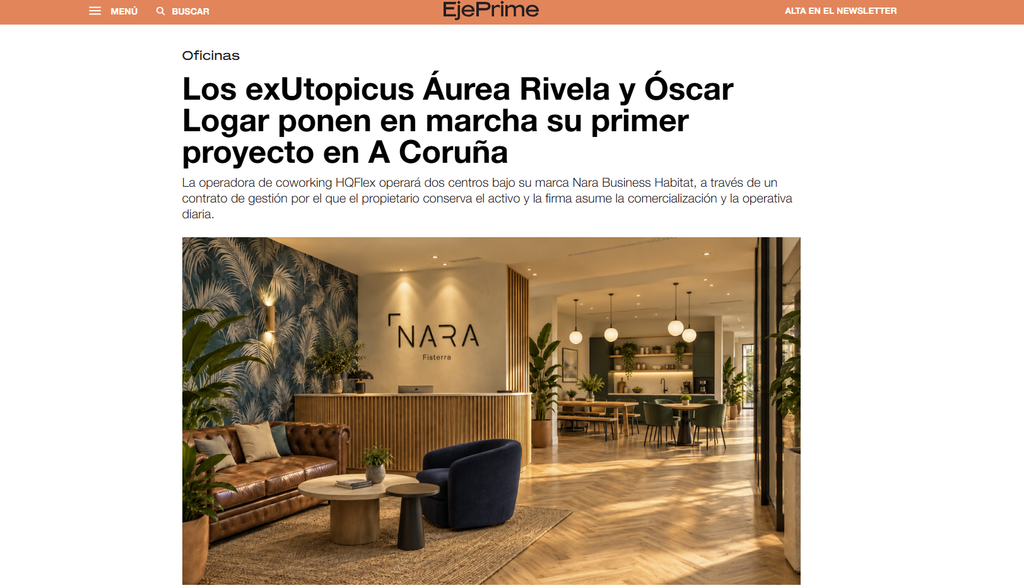
Spanish real estate publication EjePrime has featured HQFlex’s expansion into A Coruña in its Offices section, in an article titled “Former Utopicus Executives Áurea Rivela and Óscar Logar Launch Their First Project in A Coruña”, published on 9 November 2026.
The article highlights HQFlex’s arrival in the Galician city, where the company will operate two coworking and flexible office centres under its NARA Business Habitat brand: NARA Espacio Coruña and NARA Fisterra.
Together, the two locations will offer 3,525 sqm of flexible workspace, with openings scheduled between December 2026 and early 2027.
As EjePrime explains, HQFlex will operate both properties through a management agreement model, in which property owners retain ownership and control of their assets while HQFlex takes responsibility for commercialisation and day-to-day operations.
What EjePrime Says About HQFlex
The article highlights the extensive experience of HQFlex’s founding team.
Áurea Rivela and Óscar Logar bring more than a decade of experience managing Utopicus, Colonial’s coworking and flexible office platform.
During her time at Utopicus, Rivela served as Managing Director and, subsequently, Business Director. Together, the founders contributed to the opening of 15 flexible workspaces across Madrid and Barcelona, representing up to 40,000 sqm.
Since 2023, HQFlex has advised on the development and launch of flexible workspace projects for major organisations, including:
- Mutua Madrileña in Madrid.
- Startup Valencia, through Terminal Hub.
- Port Tarraco in Tarragona.
EjePrime also explores HQFlex’s distinctive approach to flexible office management agreements.
As Áurea Rivela, co-founder of HQFlex, explains:
“The owner retains the asset and control, while our remuneration depends on the workspace’s performance.”
She also highlights a fundamental shift in corporate demand:
“Companies no longer want long-term leases or to invest in fit-out works.”
These statements reflect a wider transformation in the flexible workspace industry, where adaptability, operational expertise and performance-based management are becoming increasingly important.
According to a report published by JLL and the Spanish Coworking Association in May 2026, the flexible workspace sector’s revenue is expected to grow by 15.8% in 2026.
At the same time, property owners are increasingly moving beyond traditional landlord relationships to become operational partners in flexible workspace projects.
Read the full article on EjePrime.
Two New NARA Flexible Workspaces in A Coruña
HQFlex’s expansion into A Coruña includes two complementary projects designed to meet the evolving needs of businesses, professionals and property owners.
NARA Espacio Coruña: Flexible Offices Within a Shopping Centre
Opening December 2026 | 1,350 sqm
NARA Espacio Coruña occupies 1,350 sqm on one floor of the Espacio Coruña shopping centre, located in the Someso district.
Scheduled to open in December 2026, the workspace will offer a comprehensive range of flexible office solutions, including:
- Private offices for businesses and teams.
- Dedicated and flexible coworking desks.
- Fully equipped meeting rooms.
- An outdoor terrace.
The layout is organised around a central boulevard designed to bring natural light throughout the workspace, creating an open, welcoming and functional environment.
Sutega has been responsible for the design and construction of the project under a design & build model.
The development also reflects the growing trend of integrating flexible workspaces into mixed-use commercial properties.
Espacio Coruña is already attracting corporate occupiers, with more than 400 employees from companies including Sutega, CIE and Firmatel.
The shopping centre also benefits from approximately 2,000 parking spaces, a gym, restaurants and convenient transport connections.
This combination of accessibility, services and infrastructure makes shopping centres an increasingly attractive option for flexible office developments.
Related article: Coworking in Shopping Centres: The NARA Espacio Coruña Case Study.
NARA Fisterra: An Entire Building Dedicated to Flexible Offices
Opening Early 2027 | 2,175 sqm
NARA Fisterra will occupy an exclusive-use, three-storey building covering 2,175 sqm at Avenida Finisterre 293 in A Coruña.
The property, a former industrial building converted into modern office accommodation, is scheduled to open in early 2027.
The development will feature:
- 225 workstations.
- 27 private offices.
- 10 meeting rooms.
- An event space accommodating up to 32 people.
- 9 private phone booths.
- Coworking areas and offices for teams of 1 to 12 people.
- Private office suites for 8 to 26 people.
- Larger office modules for companies requiring more than 40 workstations.
NARA Fisterra will also feature a landscaped internal courtyard, a rooftop terrace and advanced digital infrastructure, including Wi-Fi 7 and fibre-optic connectivity to every access point.
The project demonstrates how underused industrial properties can be transformed into modern, high-performance flexible workspaces.
What Is a Flexible Office Management Agreement?
A flexible office management agreement is a business model in which a property owner appoints a specialist operator to manage and commercialise a coworking or flexible office space without leasing the property to that operator.
Unlike a traditional lease, the property owner retains ownership and control of the asset.
The operator is responsible for developing the workspace offering, attracting occupiers and managing daily operations.
In return, the operator receives management fees linked to the performance of the workspace.
This structure is similar to the model widely used in the hospitality industry, where property ownership and operational management are separated into two entities:
- PropCo (Property Company): Owns and controls the real estate asset.
- OpCo (Operating Company): Manages the commercial and operational activities.
For property owners, this approach offers an alternative to traditional leasing, combining professional workspace management with direct participation in the property’s operating performance.
Which Properties Are Suitable for Flexible Office Management?
The management agreement model can be particularly attractive for several types of real estate assets.
Vacant commercial properties and offices
Buildings or units struggling to secure traditional tenants may benefit from conversion into flexible workspaces.
Underused shopping centre floors
Shopping centres often provide parking, established infrastructure, convenient access and complementary services, making them suitable for coworking and flexible office developments.
Large office buildings
Properties originally designed for single corporate occupiers can be adapted to accommodate smaller teams and businesses seeking more flexible arrangements.
Properties requiring repositioning
Former industrial buildings and other underused assets can be transformed into modern workspaces through strategic refurbishment and professional management.
Benefits of Flexible Office Management for Property Owners
For property owners, flexible office management agreements offer the potential to generate higher revenue per square metre than traditional leasing, depending on demand, occupancy, operating costs and investment requirements.
By partnering with an experienced flexible workspace operator, owners can benefit from specialist expertise in workspace design, commercialisation and day-to-day management while retaining control of their real estate assets.
This model can also support the repositioning of underperforming properties and help adapt existing buildings to changing workplace requirements.
Frequently Asked Questions About Flexible Office Management
What Is a Coworking Management Agreement?
A coworking management agreement is a contractual arrangement in which a property owner appoints a specialist operator to manage and commercialise a coworking or flexible office space.
The owner retains ownership of the property, while the operator oversees the workspace offering, sales, occupancy and daily operations. Management fees are linked to the performance of the business.
How Does a Management Agreement Differ from a Traditional Lease?
Under a traditional lease, the property owner receives an agreed rental income, while the operator assumes responsibility for the business and retains the operating results.
Under a management agreement, the property owner retains control of the asset and participates in the workspace’s financial performance, while a specialist operator manages the business.
Can a Vacant Property Be Converted into a Flexible Workspace?
Yes. Vacant offices, underused commercial premises and former industrial buildings may be suitable for conversion into flexible workspaces.
However, feasibility depends on factors such as location, local demand, building layout, refurbishment costs and potential operating returns.
Looking to Transform Your Property into a Flexible Workspace?
If you own a commercial property, office building or underused real estate asset and would like to explore whether a flexible office management agreement could be the right solution, HQFlex can help you assess its potential.
Contact us at info@hqflex.com to discuss your property and explore the opportunities available.